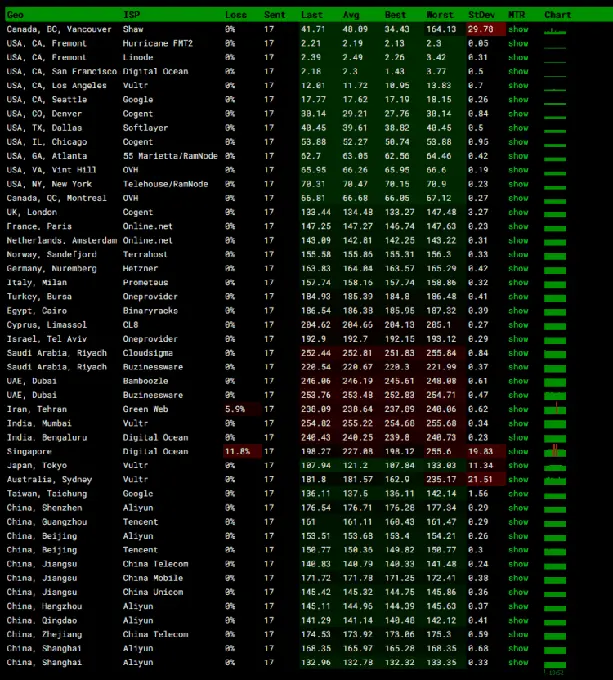
WarnerCloud US Servers: CN2 vs. Dedicated Bandwidth - Plan Comparison
This review, published on March 16, 2023, involves WarnerCloud. The test or product region is the United States. CN2 and dedicated bandwidth are mentioned in the document.


The information released on March 13, 2023, documented ServerHub's standalone servers. The nodes involved included those in the United States; the original document listed SSD and HDD as technical identifiers.
This host maintenance note, published on March 13, 2023, is titled "HostMonster Host".
The information published on March 6, 2023, documented Smarthost's VPS services. The nodes involved included those in the United States; the original document listed Linux, Windows, and IPv6 as technical identifiers.
This review, published on February 24, 2023, involves RAKsmart. The tested or product location is Silicon Valley, USA.
The information released on February 20, 2023, documented hosthatch's VPS. The nodes involved included those in the United States; the original document listed technologies such as KVM, NVMe, AMD EPYC, and SSD.
The document released on February 15, 2023, documented Spinservers' standalone servers. The nodes involved included those in the United States; the original document listed technical identifiers such as SSD, NVMe, RAID10, and HDD.
The information from February 15, 2023, focuses on CloudCone cloud servers. The regions mentioned include the United States. One set of records has been compiled according to the original table, which can be used to compare memory, CPU, hard drive, and traffic.
The information published on February 14, 2023, details gcore's cloud servers. The nodes involved include Singapore, Hong Kong, Taiwan, South Korea, Japan, and the United States; the example pricing for different configurations or billing periods is €3.0/month.
The information from February 13, 2023, concerns SpinServers' managed services. The regions mentioned include the United States. Two sets of records have been compiled according to the original table, which can be used to compare data center, CPU, memory, and hard drive information.
The document published on February 11, 2023, documented interserver VPS. The nodes involved included those in the United States; the original document listed the following technical identifiers: KVM, VMware, Hyper-V, SSD, IPv4, RAID 10, Linux, and Windows.
The information from February 9, 2023, revolves around WarnerCloud's cloud servers. The regions mentioned include Singapore, Hong Kong, and the United States. Six sets of records have been compiled according to the original table, allowing for comparison of model, processor, memory, and hard drive specifications.
The information released on January 16, 2023, documented OVH's cloud servers. The nodes involved included those in the United States; the original document listed SSD and NVMe as technical identifiers.
The information released on January 13, 2023, documented arzhost's standalone servers. The nodes involved included Hong Kong and the United States; the original document listed NVMe, KVM, IPv4, and IPv6 as technical identifiers.
The information from January 9, 2023, focuses on CloudCone cloud servers. The regions mentioned include the United States. One set of records has been compiled according to the original table, which can be used to compare CPU, memory, hard drive, and traffic.
The information from January 6, 2023, revolves around WarnerCloud's cloud servers. The regions mentioned include Singapore, Hong Kong, and the United States. Four sets of records have been compiled according to the original table, allowing for comparison of region, model, CPU, memory, and hard drive information.
The information from January 5, 2023, revolves around SugarHosts shared hosting. The regions mentioned include Hong Kong and the United States. One set of records has been compiled according to the original table, which can be used to compare plans, disk space, bandwidth, and website hosting.
The information released on January 1, 2023, documented the VPS provided by Bandwagon Host. The nodes involved included locations in New York and the United States; the technical identifiers listed in the original text included SSD, CMI, CN2 GIA, CN2, AS4837, AS9929, Windows, Linux, IPv4, NTT, pccw, cn2 gia, and Softbank.
The information released on January 1, 2023, documented Bandwagon Host's VPS. The nodes involved included Hong Kong, Japan, the United States, Canada, the Netherlands, and Australia; the technical identifiers listed in the original text included AS4837, SSD, CMI, CN2 GIA, CN2, AS9929, Windows, Linux, IPv4, cn2 gia, and Softbank.
The information released on December 29, 2022, documented the dedicated servers and VPS of soladrive.com. The nodes involved included those in the United States; the original document listed the following technical identifiers: Windows, Linux, NVMe, IPv4, SSD, and KVM.
The information released on December 28, 2022, documents CloudSigma's cloud servers and VPS. The nodes involved include Japan, the United States, the United Kingdom, Sweden, Switzerland, Australia, the Philippines, and Ireland; the original document lists the technical identifiers as Linux, Windows, KVM, NVMe, RAID 10, and IPv4.
The information from December 28, 2022, revolves around WarnerCloud's cloud servers. The regions mentioned include the United States. One set of records has been compiled according to the original table, allowing for comparison of model, CPU, memory, and hard drive specifications.
The information released on December 25, 2022, documented Megalayer's standalone servers. The nodes involved included San Jose and the United States; the original document listed the technical identifiers CN2 and CMI.
The information from December 16, 2022, focuses on the independent servers of RAKsmart and DediPath. The regions mentioned include the United States. Five sets of records have been compiled according to the original table, which can be used to compare memory, CPU, hard drive, and traffic.